
Why an Inflatable Catamaran Tender (Like the Takacat) Outperforms a Conventional Monohull Inflatable

If you own a yacht or powerboat in New Zealand, your tender is more than just a dinghy — it's your daily lifeline for shore runs, beach landings, guest transfers, and quick adventures like diving and fishing. Whether you're navigating the chop of the Hauraki Gulf or tucked into a quiet Bay of Islands cove, your tender's performance matters.
Traditional monohull inflatables (think classic roll-ups or rigid alloy floor options) have been the go-to for decades, but inflatable catamarans like the Takacat are rewriting the rules. Their twin-hull design delivers unmatched stability, superior efficiency, easier handling, and better overall versatility for tender duties.
The Advantages of Choosing an Inflatable Catamaran
The Physics of Stability: Why Two Hulls Beat One
The core advantage lies in form stability. A catamaran's dual inflatable hulls distribute buoyancy and weight far more effectively than a single monohull. In physics terms, the metacentric height is more favorable, meaning the boat resists tipping when weight is applied to one side. Think of it as a wider base that simply doesn't want to tip.
This creates a wider, more stable platform that resists rolling — even when you're boarding from a swim platform in chop, shifting gear, or carrying passengers and pets. Monohulls tend to feel skittish by comparison, especially lighter soft-bottom models. Add in the Takacat's open-bow and closed-bow options, shallow draft, and quick-draining Tube Transom® (of the LX & Sport Series), and you get a tender that's safer, drier, and more fun to use day in and day out.
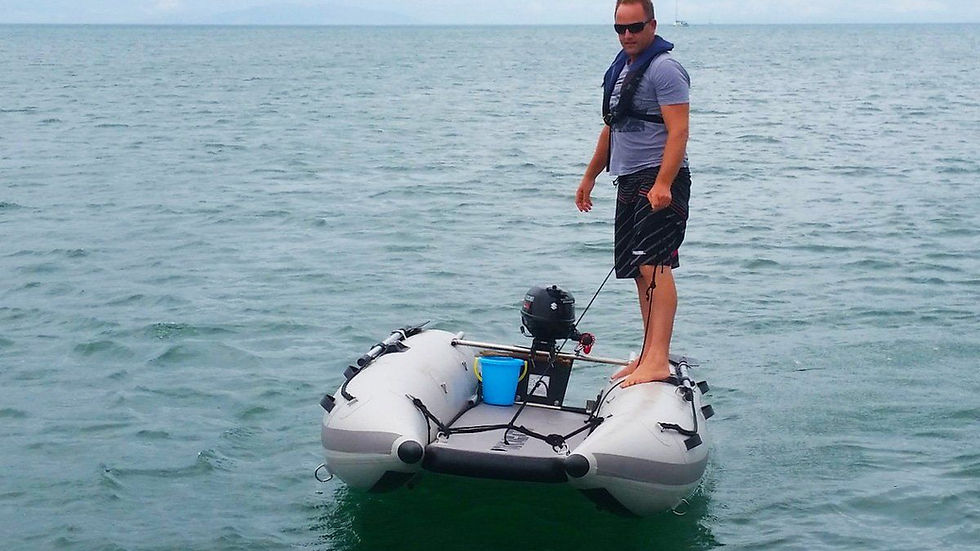
Superior Stability: The Game-Changer for Safe Transfers
Stability is critical for a tender. You're often stepping on and off in coastal swells, with the mother ship rolling or your guests clutching groceries. An inflatable catamaran's twin hulls create exceptional form stability — the boat stays level even with weight shifts or side loading. Reviewers consistently note it feels solid and free from the side rock (or tip) of traditional roll-up inflatables.
Boarding from the water (ideal for Northland diving or a quick swim stop) or a low swim platform is effortless because the boat doesn't rock or tip like a monohull. Pets and kids love it too — the stable deck reduces anxiety during transfers. In contrast, conventional monohull inflatables have a narrower effective stability. They roll more under uneven loads or in boat wakes, making transfers trickier and less safe.
Better Efficiency: Faster, Smoother, and More Fuel-Efficient
Efficiency matters when you're zipping to shore with a small outboard — typically 2.5–6 HP on a 3m tender. Inflatable catamarans plane earlier because the tunnel-hull design allows air to pass underneath, reducing wetted surface area and drag. They achieve higher speeds with less power and burn less fuel — a significant benefit for yacht owners with weight-sensitive davits.
On the fully inflatable Takacat's, the high-pressure air deck (inflated to 10 PSI) creates a rigid, non-skid platform that keeps everything steady while the cat design slices through the water efficiently. It glides comfortably even with modest horsepower. Monohull inflatables often need more throttle to get on plane and feel draggy at low speeds. RIBs with a fixed alloy floor handle rough water well but are heavier overall, requiring more power — and fuel — for the same performance.
Check out the Video comparing a conventional monohull and a Takacat Tender being towed behind a powerboat.
Pros and Cons: Inflatable Catamaran vs. Conventional Monohull Inflatable
Pros of Inflatable Catamaran (e.g., Takacat):
Exceptional stability with minimal roll — safer boarding and passenger movement in NZ chop.
Higher efficiency: planes at lower speeds, excellent speed and fuel economy even with 2.5–6 HP engines.
Ultra-lightweight: at 29 kg, significantly easier to lift onto davits or pull up a beach.
Open-bow and closed-bow options: effortless beaching and boarding from the water or dock.
Self-draining: the Tube Transom® ensures the boat drains instantly, no bailing required.
Lower overall weight makes handling with davits or by hand far easier.
Durable thermally welded construction with pet-friendly fabric options.
Cons of Inflatable Catamaran:
Wider beam can require more care when stowing in tight or custom-moulded davits.
Higher windage when empty — sits higher on the water than a heavy RIB in a gust.
Pros of Conventional Monohull Inflatable:
Familiar design with a potentially deeper V-hull for rough-water slicing.
Often simpler seating layout with a more enclosed feel in some models.
Highfield-style aluminium RIBs offer rugged durability for heavy beaching and abuse.
Cons of Conventional Monohull Inflatable:
More prone to tipping and rolling during boarding or weight shifts.
Higher drag and later planing — less efficient with small engines.
Can deliver a harsher, slapping ride.
Heavier overall (especially RIBs), harder to stow or lift.
Narrower stability margin in chop or with moving passengers.
Head-to-Head: 3m Takacat vs. 3m Zodiac vs. 3m Highfield
Using the closest comparable ~3m models: Takacat T300LX (3.0m), Zodiac Cadet 310 Aero, and Highfield Classic 290 RIB (2.9m). Specs are manufacturer-reported.
| Feature | Takacat T300LX | Zodiac Cadet 310 Aero | Highfield Classic 290 |
|-----------------------------|-----------------|------------------------|------------------------|
| Length | 3.0 m (9'10") | 3.1 m (10'2") | 2.9 m (9'6") |
| Beam | 1.55 m (5'1") | 1.55 m (5'1") | 1.70 m (5'7") |
| Dry Weight | 29 kg (64 lbs) | 35 kg (78 lbs) | 59 kg (130 lbs) |
| Payload | 367 kg (809 lbs) | ~570 kg (1,257 lbs) | 320 kg (705 lbs) |
| Max Persons | 4 | 5 | 4 |
| Max HP | 9.9 HP | 10 HP | 20 HP |
| Tube Diameter | 48 cm (19") | ~43 cm (17") | 44 cm (17") |
| Hull Type | Dual catamaran + air deck | Single monohull + air floor | Aluminium V-hull + tubes |
| Stability | Outstanding — dual hulls resist roll | Good, but prone to rolling | Solid rigid hull, heavier feel |
| Efficiency | Excellent — planes early, low drag | Decent, higher drag | Good in chop, needs more power |
| Portability | Packs into 2 small bags | Packs into 1 bag | Rigid hull limits folding |
| Best For | Max stability, easy beach access, light stowage | Budget-friendly inflatable versatility | Rugged short trips, heavy landings |
The Takacat stands out clearly for tender use: lighter, more stable, and more efficient, while matching or beating payload in a compact package. The Zodiac offers solid value but lacks the cat's poise. The Highfield is tougher for rough landings but sacrifices portability and ease of use.
Final Verdict: Upgrade to a Catamaran Tender
For most New Zealand yacht and powerboat owners, an inflatable catamaran like the Takacat T300LX is the smarter choice. It delivers the stability you need for confident transfers, the efficiency that saves time and fuel on every shore run, and the packability that makes life aboard genuinely easier. While conventional monohull inflatables still have their place — particularly rugged RIBs for heavy-duty beaching — the catamaran design simply outperforms them as a versatile, user-friendly tender.
If you're tired of a tippy, draggy dinghy that fights you every time you load it up, it's time to go Takacat. Your crew — and your back — will thank you.


